Blind-positive. Sex-positive. Led by lived experience.
Our whole selves belong here.
Our identities, relationships, pleasure, and access are connected. Explore blindness, ableism, internalized ableism, and disability justice, starting with the questions that matter to you.
Blind adults lead this learning space. Families, educators, providers, and the wider community are welcome to learn alongside us.
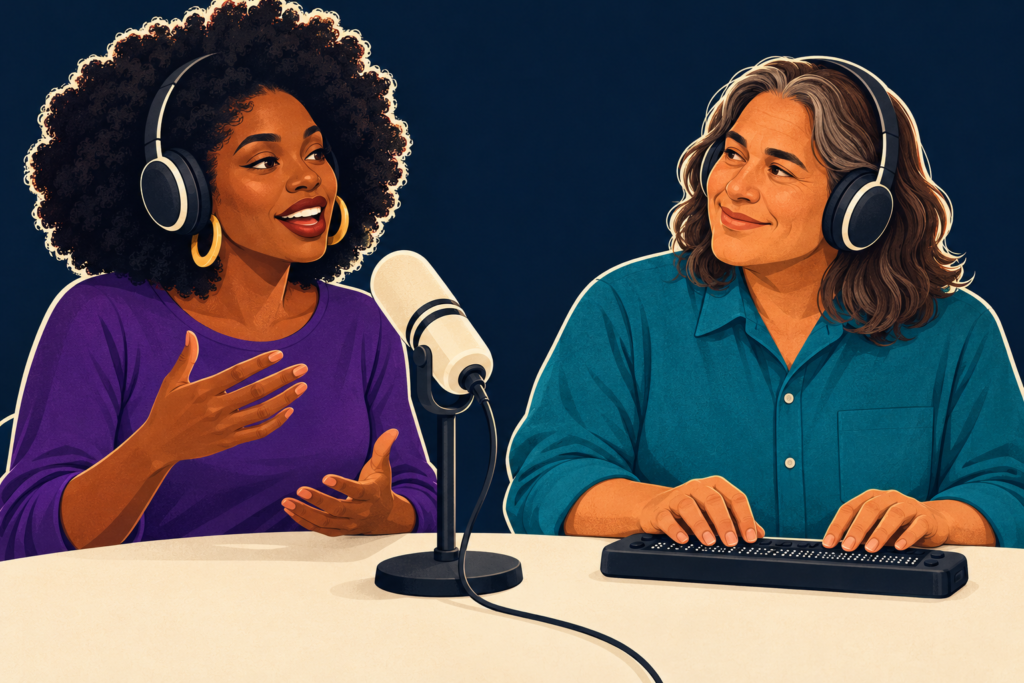
Image description: recording a conversation
Two illustrated adults sit at a cream table against navy. A Black woman with a natural Afro, gold earrings, and a purple shirt speaks beside a cream microphone. A tan adult with shoulder-length brown and gray hair wears teal and reads a refreshable Braille display. Both wear headphones. The device’s dots are illustrative, rather than a readable passage.
Whole people.
Full lives.
Our choices.
Learn from blind voices
Explore lived experience, practical teaching, and community perspectives by topic. Each article or recording names its author, creator, and original publication. You can share feedback directly from its listing.
Everyday consent and bodily autonomy: 3 articles
BSAN cofounder writing
Stop Touching Blind People
Laura connects unwanted grabbing and steering with bodily autonomy. A practical entry point for talking about everyday ableism and asking before offering assistance.
Why BSAN includes Stop Touching Blind People
Use it to connect consent on the sidewalk with consent in classrooms, clinics, friendships, and intimate relationships.
Not yet rated. Share feedback on Stop Touching Blind People
BSAN cofounder writing
The Need for Consent When Participating in Orientation and Mobility and Other Structured Discovery Adventures
Laura draws on her own orientation and mobility training to explain informed consent, clear expectations, touch, and a learner’s ability to stop an activity.
Why BSAN includes Laura’s informed-consent article
Connects consent education with everyday blindness training and the learner’s agency.
Not yet rated. Share feedback on Laura’s informed-consent article
BSAN cofounder writing
Why Consent Is So Radical: Childism, Power, and Everyday Autonomy
Laura reflects on consent, adult power, and children’s everyday autonomy, drawing on disability justice, public health, and lived experience.
Why BSAN includes Why Consent Is So Radical
Useful for questioning practices that reward compliance while leaving little room for a child’s questions, preferences, or refusal.
Not yet rated. Share feedback on Why Consent Is So Radical
Identity, belonging, and solidarity: 4 articles
Blind perspective · Outside article
Fateful Intersectionality
A gay blind man reflects on disclosure, belonging, internalized ableism, and exclusion in blindness rehabilitation, followed by a return to community.
Why BSAN includes Fateful Intersectionality
Asks what meaningful inclusion looks like when people bring their whole identities into blind spaces.
Not yet rated. Share feedback on Fateful Intersectionality
BSAN cofounder writing
The Price of Silence: Why Blind and LGBTQ Advocacy Must Stand Together
Laura’s perspective on solidarity between blind and LGBTQ+ advocacy, and making space for people who belong to both communities.
Why BSAN includes The Price of Silence
A starting point for examining whose voices are heard, whose needs are overlooked, and what solidarity asks of us.
Not yet rated. Share feedback on The Price of Silence
Blind perspective · Outside article
Being Black Helped Me Be Blind and Being Blind Helped Me Understand that #BlackLivesMatter
Anil Lewis connects his experiences as a Black man and a blind man, reflecting on systemic racism, ableism, community, and his responsibility to keep learning and act.
Why BSAN includes Anil Lewis’s article
A first-person entry point for discussing overlapping identities and solidarity across movements.
Not yet rated. Share feedback on Anil Lewis’s article
BSAN cofounder writing
Pride Never Ends: Building Inclusive Education for Blind and Queer Youth
Laura brings blindness and queer inclusion into the same conversation about education and belonging.
Why BSAN includes Pride Never Ends
For adults supporting young people, inclusion means offering information and choices without deciding someone else’s identity or future.
Not yet rated. Share feedback on Pride Never Ends
Pleasure and access: audio with a transcript, for adults 18+
Blind-led audio · Adults 18+
Blind Grown & Sexy
Thomas Reid and guests ask what gets lost when sexual content is left undescribed or stripped of its feeling. Explore pleasure, consent, identity, and the art of access.
Not yet rated. Share feedback on Blind Grown & Sexy
Start with what matters to you
Choose any topic. Each opens a short BSAN learning note with an example or question. Read, reflect, discuss with someone, or pass. There is no required order.
01
Blind identity and belonging
You get to describe your blindness and decide what belonging means to you.
Explore blind identity and belonging
Blindness is a spectrum. People use different combinations of sight, sound, touch, language, technology, mobility tools, and support. No single way of reading, moving, or seeing makes someone the model blind person.
Identity-first language such as “blind person” can express community and pride. People also choose other language. Ask, listen, and respect the words a person uses for themself. DeafBlind people and people with additional disabilities belong here.
Try asking: Which parts of my identity do I want to name, and which details do I want to keep private?
In relationships: You can explain an access preference without sharing a diagnosis or proving how much you can see.
02
Recognizing ableism
Notice the assumptions, interactions, and systems that limit people’s choices.
Explore recognizing ableism
Ableism is a system that treats some bodies and minds as more valuable than others. It can shape who is believed, desired, included, or allowed to make decisions.
- Interpersonal: A provider speaks to your companion instead of you.
- Structural: Sexuality information is available only in visual diagrams.
- Cultural: A story assumes blind people are helpless, asexual, or automatically inspirational.
- Internalized: Repeated messages influence what you believe you deserve.
Try saying: “Please speak directly to me and explain the options in a format I can use.” Responsibility for respectful, accessible service remains with the provider.
03
Unlearning internalized ableism
Make room to question messages about worth, attractiveness, help, and independence.
Explore unlearning internalized ableism
Internalized ableism can happen when society’s devaluing messages become part of how we judge ourselves or other disabled people. This is learned in an ableist world. It is not a personal failure.
It might sound like “I should be grateful anyone wants me” or “Asking for access makes me a burden.” These messages can be questioned. Needing support does not lower your worth or make you owe someone intimacy.
Try asking: Am I choosing this because I want it, or because I was taught I should accept it?
You can feel pride, grief, frustration, pleasure, or uncertainty about disability. There is no required emotional response and no deadline for feeling differently.
04
Practicing disability justice
Ask who leads, who is missing, and what changes when access is shared.
Explore practicing disability justice
Disability justice connects access with power, identity, and collective life. Sins Invalid’s principles offer a framework for thinking about leadership, interdependence, and whose needs get overlooked.
At BSAN, that means making room for people who are DeafBlind, multiply disabled, queer, trans, Black, Indigenous, or otherwise pushed to the margins. One blind person’s experience cannot speak for everyone.
Put it into practice: Offer multiple ways to participate, plan breaks, make materials usable without sight, and involve the people affected in decisions.
Try asking: Who could not take part in this event, lesson, or conversation, and what would need to change?
05
Identity and intersectionality
Our experiences of blindness are shaped by our whole lives and overlapping systems of power.
Explore identity and intersectionality
Intersectionality helps us understand how systems such as racism, ableism, sexism, queerphobia, and economic exclusion interact. These experiences cannot always be understood separately.
A blind person’s access to respectful sexual healthcare can also be shaped by race, gender, language, money, migration, culture, or additional disabilities. Blindness does not erase these differences.
Try asking: Whose experience am I treating as typical? What would I learn by listening to people with different experiences?
You do not need to share every part of your identity to belong. Choosing when, where, and whether to disclose is part of autonomy.
06
Access, care, and consent
Getting support and making your own choices can happen together.
Explore access, care, and consent
Independence can include support you choose. Interdependence recognizes that people rely on one another. You still get to set boundaries around touch, information, relationships, and care.
Try saying: “Please ask before guiding me.” “Describe what you mean.” “I want the information, and I’ll decide whether to use it.”
Learning about visual social cues can expand your options. Making eye contact or performing sighted behavior should not be a condition of respect, connection, or receiving education.
Remember: Assistance does not create an obligation to flirt, date, disclose private information, or accept touch. Educators and providers can offer knowledge while respecting the learner’s choices.
Community resources and foundations
Choose a collection for short listings, formats, and direct feedback links. Outside work remains on its original website.
Disability justice, internalized ableism, and access: 4 resources
Usher community resource · Outside source
On Well-Being: Internalized Ableism
An introduction to absorbing society’s ableist messages, with examples involving accommodation requests, belonging, and pressure to prove disability.
Why BSAN includes Internalized Ableism
Makes room for a conversation about asking for access without having to justify your worth or disclose more than you choose.
Not yet rated. Share feedback on Internalized Ableism
Disability justice framework · Outside source
Sins Invalid: 10 Principles of Disability Justice
Ten interconnected principles address leadership, identity, shared access, mutual reliance, and collective freedom.
Why BSAN includes Sins Invalid’s principles
These principles help BSAN ask who leads, who is missing, and how our learning spaces can support people with different and overlapping access needs.
Not yet rated. Share feedback on Sins Invalid’s principles
Disability justice framework · Outside source
Working Definition of Ableism (English & ASL)
A living definition that connects judgments about bodies and minds with wider systems of power and exclusion.
Why BSAN includes the working definition of ableism
Invites us to examine assumptions about desirability, productivity, behavior, and whose life is valued. Follow the link to the author’s definition and access notes.
Not yet rated. Share feedback on the working definition of ableism
Disabled lived experience · Outside source
Access Intimacy: The Missing Link
Mia Mingus names the connection that can emerge when access needs are understood and welcomed.
Why BSAN includes Access Intimacy
A useful lens for friendship, community, care, and intimate relationships. Meeting an access need never creates a debt of affection or sexual availability.
Not yet rated. Share feedback on Access Intimacy
More sexuality, disability, and LGBTQ+ resources: 3 resources
Disabled youth perspective · Outside source
Sex, Etc.: Dating with a disability or chronic illness
A disabled young person shares ideas for connection and dating while living with disability and chronic illness.
Why BSAN includes Dating with a disability or chronic illness
Adds a peer perspective alongside the blindness-specific material in our young people’s collection.
Not yet rated. Share feedback on Dating with a disability or chronic illness
LGBTQ+ information and support · Outside source
The Trevor Project: LGBTQ+ Resource Center
Information about sexual orientation, gender identity, allyship, and LGBTQ+ community life.
Why BSAN includes The Trevor Project’s Resource Center
A broader identity resource for young people and supporters, alongside BSAN’s blind and queer perspectives.
Not yet rated. Share feedback on The Trevor Project’s Resource Center
Sex-positive learning · Outside source
Scarleteen: Sexuality and relationships
Inclusive sexuality and relationships education centered on young people’s questions.
Why BSAN includes Scarleteen
Offers another place to explore bodies, identity, consent, and relationships while bringing your own access needs and lived experience.
Not yet rated. Share feedback on Scarleteen
Relationships, body confidence, and professional learning: 4 resources
DEAFBLIND AUTHOR · OUTSIDE BOOK
Dear Blind Lady: Disability Advice You Didn’t Know You Needed
A Deafblind author’s practical advice about dating, relationships, unwanted help, boundaries, and responding to ableism. Includes scripts for everyday conversations.
Find this book on the BSAN reading shelf.
Not yet rated. Share feedback about Dear Blind Lady: Disability Advice You Didn’t Know You Needed.
DISABLED LIVED EXPERIENCE · OUTSIDE ARTICLE
Body and Sexuality Disconnects with Disability
Supportive advice about body shame, desire, feeling excluded from dating, and building a relationship with your own sexuality. Addresses disability broadly rather than blindness specifically.
Not yet rated. Share feedback about Body and Sexuality Disconnects with Disability.
CROSS-DISABILITY LIVED EXPERIENCE · OUTSIDE BOOK
Disability Intimacy: Essays on Love, Care, and Desire
Disabled people’s first-person writing about intimacy, relationships, care, friendship, and access. Broadens intimacy beyond intercourse and romantic partnerships.
Find this book on the BSAN reading shelf.
Not yet rated. Share feedback about Disability Intimacy: Essays on Love, Care, and Desire.
DISABILITY JUSTICE · OUTSIDE PROFESSIONAL NETWORK
AASECT Sexuality Disability Justice Special Interest Group
A professional learning and networking group centering disabled people’s experiences and accessibility in sexuality education, counseling, and therapy. Its aims include disability justice, intersectionality, and continuing education. This is a professional network, not a therapist referral directory.
Not yet rated. Share feedback about AASECT Sexuality Disability Justice Special Interest Group.
Bring these ideas into everyday life
- For yourself: Name one access preference or boundary that would make an interaction work better for you.
- With someone else: Ask what support they want, listen to the answer, and leave room for it to change.
- When teaching or providing care: Offer information and options. Avoid treating eye contact, sighted behavior, or compliance as proof of understanding or readiness.
- In a group: Ask who is missing from the conversation and make participation possible in more than one way.
Continue with adult pleasure and intimacy, young people’s resources, kids and families, or resources for educators and providers.
Help this learning space grow
Which message have you had to unlearn? What helped you feel that you belonged? Share a perspective, a useful practice, or an access experience. You choose how much to share.
Share a perspective on this learning path
BSAN reviews submitted contributions before publication. To comment on a specific resource, use that resource’s own feedback link.
Have something new to recommend? Suggest a resource on the separate submission page.
Back to the six topics · Browse all resources · Read the BSAN Blog